
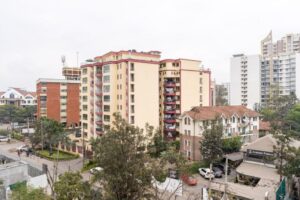
Kilimani and Kileleshwa share a boundary, a lot of new apartment towers and the same pull towards the city centre. Yet they offer quite different lives. Kilimani is busier, more commercial and generally more expensive. Kileleshwa is quieter, leans towards families and longer leases, and usually costs less for the same number of bedrooms.
That is the short answer to the Kilimani vs Kileleshwa question. If you want restaurants, shops and offices within a short walk, and you are happy with a smaller flat, Kilimani tends to suit. If you want more space for your money, a calmer street and neighbours who stay for years, Kileleshwa usually fits better. The rest of this guide covers the details that should decide it for you, including what moving day looks like in each.
The two estates side by side
Rents below are the ranges published by VillaWatch Kenya in April and June 2026, the same source for both estates so the figures compare fairly. Individual listings vary widely with building age, finishes and amenities, so treat these as a guide and check current listings before you decide.
| Kilimani | Kileleshwa | |
|---|---|---|
| 1-bedroom rent | KES 50,000 to 90,000 | KES 38,000 to 60,000 |
| 2-bedroom rent | KES 80,000 to 150,000 | KES 50,000 to 90,000 |
| 3-bedroom rent | KES 130,000 to 250,000 | KES 75,000 to 140,000 |
| Character | Mixed homes, offices, restaurants and malls | Mainly residential, less commercial |
| Typical tenant | Professionals, expatriates and young families, plus a busy short-let market | Families and senior professionals on longer leases |
| Common flat sizes | Studios and one-bedrooms | A wider spread, including larger family units |
| Main drawbacks | Traffic, scarce parking, noise near the restaurant strip | Road and water pressure from rapid building |
Service charges come on top of rent in most modern blocks. VillaWatch puts well-managed Kilimani developments at KES 8,000 to 20,000 a month. Ask for the exact figure, and what it covers, before you sign anywhere.
Three questions that usually settle it
Who is moving in with you?
A single professional or a couple without children often gets more from Kilimani. Yaya Centre and Adlife Plaza are on the doorstep, Junction Mall and Prestige Plaza are about ten minutes away, Argwings Kodhek Road has a long run of cafés and restaurants, and studios and one-bedrooms are easy to find. Kilimani has its share of young families, but families often lean towards Kileleshwa, where tenants skew towards households on longer leases and streets are generally quieter. Kileleshwa Primary School serves the area, and private schools such as Braeburn in Lavington and Riara’s Kilimani campus are close by.
Where do you go every morning?
Both estates are close to the city centre and Upper Hill, but the route matters more than the distance. Kilimani residents feed onto Ngong Road and Argwings Kodhek Road, where peak-hour congestion can add 20 to 40 minutes to a trip. Kileleshwa has its own pressure: in a survey by the Kileleshwa Ward Neighbourhood Association, reported in May 2026, 95% of respondents said traffic had become much worse over the past decade. Where you work shifts the balance too. Kileleshwa is close to Waiyaki Way, the main route to Westlands, while Kilimani is better placed for Upper Hill and the hospitals there, including Nairobi Hospital. The only reliable test is to do your commute from the building at the hour you would actually travel, before you sign.
How much noise can you live with?
Kilimani’s restaurant strip is one of its attractions, and one of its complaints: noise from the bars and restaurants along Argwings Kodhek Road can be an issue for residents nearby. Kileleshwa is calmer, but both estates have construction sites where old houses are being replaced by towers. Ask the caretaker whether a building is going up next door, and walk the street on a weekday morning to hear it for yourself.
What to test before you sign
Rent and location are easy to compare online. These things are not, and they affect daily life more than a nicer kitchen:
- Water. In the same KIWANA survey, 85% of Kileleshwa respondents said water supply had got worse. Ask whether the building has a borehole or storage tanks, how often supply is rationed, and who pays when water is trucked in. Many modern Kilimani complexes also rely on boreholes, so ask the same questions there.
- Power. Check that the generator covers the lift and the water pumps, not just the corridor lights.
- Parking. Parking has become scarce in Kilimani as density has risen. Confirm how many bays come with the flat, and where visitors park.
- Internet. Ask which fibre providers already serve the building and how long installation usually takes. If you work from home, a week without internet costs more than a slightly higher rent.
- The lift and stairs. Measure the lift and the tightest turn to the door against your largest furniture. A beautiful flat is less appealing if your sofa cannot reach it.
- Drainage. Look at the compound and the road outside after rain. Wood Avenue in Kilimani was rebuilt in April 2026 with a new drainage system after months of flooding had left it nearly impassable, which shows how badly heavy rain can hit parts of the area.
Which estate fits your situation
Most people fall into one of a few groups. Here is how the choice tends to play out for each.
Starting out on your own. Kilimani’s studios and one-bedrooms, and the shops and cafés within walking distance, make it an easy first address for a young professional. Kileleshwa gives you more space for the same rent, but fewer places to walk to in the evening.
Growing family. Kileleshwa is the more common choice. Larger units, longer leases and a quieter feel suit school runs and early nights. Check the school commute at the real time of day, because school traffic can be as heavy as the office rush.
Working from home. Noise matters more than the view. A Kileleshwa flat away from building sites, or a Kilimani unit on the side of the building facing away from the main road, will make long working days easier.
On a short contract. Kilimani has a busy market in furnished, serviced and short-let apartments. If you only need a place for a year or less, it is usually easier to find something ready to move into.
Moving from a house into a flat. Either estate works, but your furniture may not. Kileleshwa’s larger units take more of it. In Kilimani you may need to sell, give away or store some pieces before the move.
How moving day differs
Moving into either estate usually means an apartment with a lift, building rules and a management office. The details differ.
In Kilimani, the challenge is usually the street. Parking is tight, the main roads jam at predictable hours, and many buildings have little space for a lorry. Getting the building’s rules in writing and timing the lorry between traffic peaks makes the biggest difference. Our guide to moving into a Kilimani apartment covers the rules, the timeline and Kilimani’s traffic windows.
In Kileleshwa, the challenge is more often the building. The estate mixes older walk-ups of five or six floors, some without lifts, with towers of 15 storeys or more that have lifts and basements but stricter procedures. Our guide to moving into a Kileleshwa apartment covers lifts, basement clearance and stair carries.
If you are moving between the two estates, the drive is short, so almost all the planning goes into the two buildings. Book lift slots at both ends, and check that both sets of moving hours overlap on your chosen day.
Timing matters in both. The end of the month, the first days of a new month, weekends and December are the busiest times for movers in Nairobi, and also when lifts are most often double-booked by other tenants. A weekday in the middle of the month is usually easier, and often cheaper.
Still deciding? Keep your options open
If your lease ends before you have found the right flat, you do not have to rush. We can collect your belongings, keep them in storage in Nairobi and deliver them once you have signed, whichever estate you choose.
When you have decided, our movers in Kilimani and movers in Kileleshwa pages show how we handle apartment moves in each estate. You can also send us your move details for a fixed quote.