
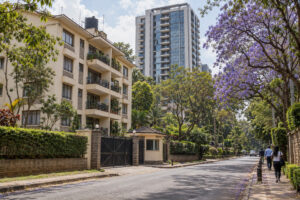
Living in Kileleshwa suits people who want a quieter, mainly residential estate close to the city centre, Westlands and Kilimani. It mixes older walk-up blocks and maisonettes with new apartment towers, and it leans towards families and longer leases. The trade-offs are real: construction as old plots are redeveloped, heavy traffic at peak hours, regular water interruptions and fewer shops within walking distance than in Kilimani. Before you move in, the things that most affect daily life are your building’s water storage, the electricity meter, security arrangements and the move-in rules.
This guide covers what the estate is like, what rent costs, how to get around, where to shop, how reliable water and power are, and what to settle before your first night.
What Kileleshwa is like
Kileleshwa sits west of the city centre. The Kirichwa River separates much of it from Kilimani and Muthangari, and the Nairobi Arboretum, a forest reserve managed by the Kenya Forest Service off State House Road, is close by for walking and running. The Arboretum charges an entry fee, so check the current rate before you go.
The housing is a mix. Older five- and six-storey walk-ups, some without lifts, stand beside towers of 15 storeys or more with lifts, basements and stricter building rules. Many of the older maisonettes and family homes on large plots are being replaced by apartments.
That change is likely to continue. According to press reports on Nairobi County’s 2026 zoning rules, the county will generally allow buildings of up to about 30 floors in Kileleshwa, subject to plot size and infrastructure approvals. The Kileleshwa Ward Neighbourhood Association (KIWANA) has opposed the policy, arguing that roads, water and drainage cannot cope. Building sites are likely to remain part of estate life for some years. Walk your street on a weekday morning before you sign, and ask whether the plot next door has approval to build.
What rent costs in Kileleshwa
Kileleshwa rent depends heavily on the building’s age, finishes and amenities, and published ranges disagree. Here is what three property sites reported in 2026 for apartments. All are indicative asking rents, and none publishes its method.
| Size | Afriqahome (Mar 2026) | VillaWatch Kenya (Jun 2026) | Bueno Property (Jul 2026) |
|---|---|---|---|
| One-bedroom | KES 40,000 to 79,000 | KES 38,000 to 60,000 | KES 25,000 to 60,000 |
| Two-bedroom | KES 55,000 to 100,000 | KES 50,000 to 90,000 | KES 40,000 to 120,000 |
| Three-bedroom | KES 70,000 to 150,000 | KES 75,000 to 140,000 | KES 70,000 to 200,000 |
The overlap is a fair starting point: roughly KES 40,000 to 60,000 for a one-bedroom, KES 55,000 to 90,000 for a two-bedroom and KES 75,000 to 140,000 for a three-bedroom in an ordinary building, as of mid-2026. New towers with pools, gyms and furnished units sit above these ranges. Check live listings for the street you want, because a few hundred metres can change the price.
Rent is not the whole monthly cost. Ask whether water, service charge, garbage collection and parking are included or billed separately. For the deposit, one Nairobi letting agency says most landlords ask for one to two months’ rent plus the first month in advance, so budget for up to three months’ rent before you get the keys.
If you are still choosing an estate, our comparison of Kilimani and Kileleshwa sets the two side by side.
Getting around
Kileleshwa is close to the city centre, Upper Hill, Westlands and Kilimani, and Waiyaki Way and Ngong Road are within easy reach. Matatu route 48 is listed under Nairobi’s route numbering as Town to Riverside to Kileleshwa. Ride-hailing is widely used for trips within the area.
The problem is peak-hour traffic, which KIWANA says has worsened as the estate has grown denser. If you commute, time the journey from your actual building at the hour you would leave for work before you sign the lease. The same applies to the school run, which can be as slow as the office rush.
Shops and daily errands
Kileleshwa is mainly residential, so you will find fewer shops and restaurants within walking distance than in Kilimani. Kasuku Centre is a local shopping centre for everyday errands. For larger supermarkets and malls, the nearest options include Yaya Centre on Argwings Kodhek Road, Sarit Centre in Westlands and The Junction on Ngong Road.
Water supply: plan for interruptions
Water is the utility to plan around most carefully in Kileleshwa. Kileleshwa has appeared on several recent water interruption notices from Nairobi City Water and Sewerage Company (NCWSC):
- 20 to 22 March 2026: a burst on the Kabete to Kilimani transmission pipeline cut supply to Kileleshwa, Kilimani and Upper Hill for about two days.
- 11 to 12 September 2026: a 26-hour shutdown for repairs on the Sasumua to Kabete pipeline listed Kandara Road, Gichugu Road, Othaya Road, Laikipia Road and Kaputei, among other parts of Kileleshwa.
- Mid-October 2026: a 24-hour interruption while a bulk supply pipeline serving Gigiri and Kabete was repaired listed Kileleshwa, Lavington, Kilimani and Westlands.
Before you sign, ask the caretaker how big the building’s storage tanks are, whether there is a borehole, how long the tanks last during a shutdown, and who pays when water has to be trucked in. Follow NCWSC’s official channels for shutdown notices, and keep some water stored in the flat. A few large jerrycans filled before an announced shutdown can tide you over a short shutdown.
Electricity and backup power
Ask whether your flat has its own Kenya Power meter, whether it is prepaid (tokens) or postpaid, and what the meter number is. On a postpaid meter, ask for proof that the previous tenant’s bill has been cleared, so you do not inherit arrears. In a tower, check that the backup generator covers the lift and the water pumps, not only the corridor lights. A building where the lift stops in a power cut is a different place to live on the twelfth floor.
Security
Security tops residents’ concerns in the most recent ward poll. In a poll of 220 ward residents by Instream Consulting Group, carried out between 30 July and 10 August 2026, security and policing was named as the most pressing local issue by 32% of respondents, ahead of drainage and sewage at 19%. There are no published crime figures for the estate, so judge your own building instead. Ask how many guards are on duty at night, whether there is CCTV covering the gate and parking, how visitors and deliveries are logged, and whether the residents’ association has a security arrangement for the street.
Before your first night: what to sort out
- Get the building’s move-in rules in writing. Lift bookings, permitted hours and gate passes vary by building. Our guide to moving into a Kileleshwa apartment covers the questions to ask.
- Do a handover inspection. Photograph walls, floors, fittings and appliances, note any damage on the inventory, and send it to the landlord or agent the same day. This protects your deposit.
- Record the meter readings. Photograph the electricity and water meters on the day you take possession.
- Check the rainy-season risks. Ask whether the basement or ground floor has taken water. Our guide to Kileleshwa flooding and drainage explains what to look for.
- Ask which internet providers serve the building. Fibre options differ from one building to the next, and installation is not always immediate, so book it before you move if you work from home.
- Save the important numbers. The caretaker, building management, the guard house and your nearest police station.
Questions to answer before choosing a Kileleshwa flat
Is Kileleshwa a good place to live if you work from home?
Compare the actual flats on your shortlist rather than choosing by the estate name. Test mobile reception inside the room you would use as an office, ask which fibre providers already enter the building, and check whether the router and your devices can run during an outage. Visit during normal working hours to hear nearby construction, generators and traffic. A quiet viewing on Sunday does not tell you what a Tuesday video call will be like.
What should a Kileleshwa rental budget include?
Write down the rent, service charge, parking, water billing, electricity arrangement and internet cost separately. Then list the one-off amounts: deposit, advance rent, any moving deposit and your relocation quotation. Ask which charges are refundable and who receives each payment. Two apartments with similar advertised rent can have different total costs, particularly if one bills water or an additional parking bay separately.
Should you choose an older apartment or a new tower?
Inspect what matters to your household. In an older block, check the staircase width, ventilation, plumbing and furniture route. In a tower, check lift capacity, generator coverage, water pumping and the management process for deliveries. Ask who handles a lift breakdown outside office hours. A newer finish does not answer these operational questions.
How can you compare two buildings fairly?
Use the same questions at both viewings. Photograph the electricity meter with permission, record the permitted moving hours, measure the sofa route and ask about maintenance reporting. Keep a short scorecard for commute, monthly cost, daylight, noise, water and access. Give extra weight to your non-negotiables, such as step-free access or a workable school run. This is more useful than counting amenities you may rarely use.
Once you have a shortlist, use the Nairobi moving checklist to connect the property handover with packing and transport. If two lease dates leave a gap, decide how temporary household storage will fit into the plan before committing to collection.
Moving to Kileleshwa
Space Move’s office is at Haven Cottage on Othaya Road, Nairobi. When you ask for a quote, include the building name, the floor, whether there is a lift, where a lorry can park and the building’s permitted moving hours. We use those details in the survey, which is done by video call or in person, so the quotation reflects the real access at both addresses. If your lease dates do not line up, ask about storage for the gap.
Planning your move to the neighbourhood? Our Kileleshwa moving team can review your inventory, building access and preferred date before preparing a quotation.